
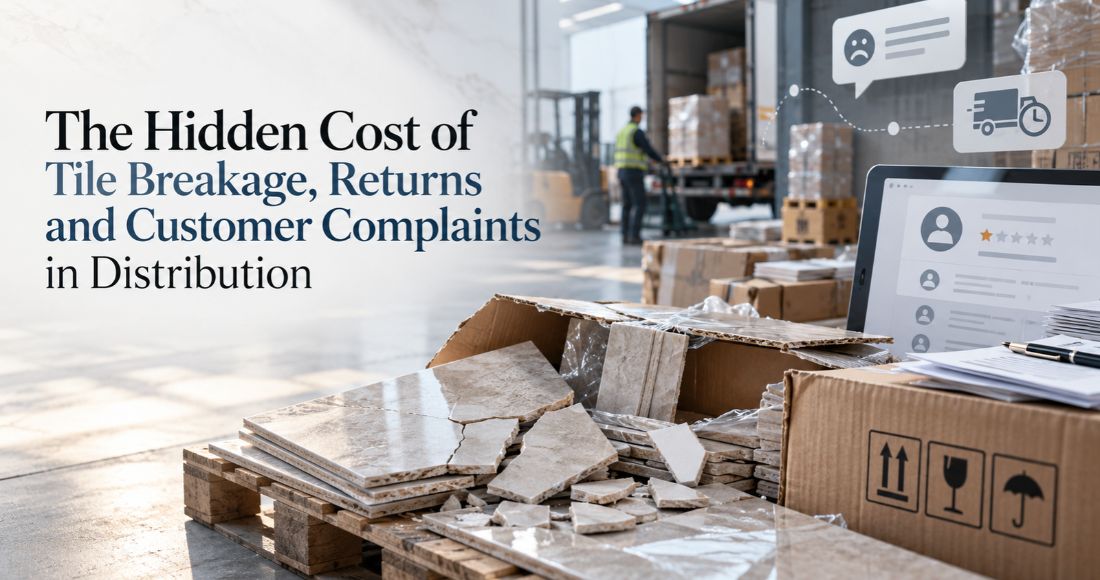
The Hidden Cost of Tile Breakage, Returns and Customer Complaints in Distribution
Cost does not always stop at just a broken tile.
In tile shipping, a box that is damaged might seem like nothing more than an operational hiccup. Tiles get broken, a replacement is made, and everything proceeds as usual.
However, the cost of the replacement is just one element of the equation.
Someone has to assess the damage, confirm the claim, check the inventory, ship another batch, and justify the delay. The dealer may need an answer. The contractor may have work suspended pending the response. The customer may begin to doubt whether the whole shipment will prove reliable.
Even if the tiles make it to the destination without breaking, there may still be problems with wrong quantities, mismatched items, or shades, sizes, and finishes being questioned.
From a distributor's point of view, it is not just about managing stock but also about dealing with labour costs and strained client relations.
Look beyond replacement value to understand the true cost
Breaking out individual cases of breakage and returns makes them easy to underestimate. A better way would be to look at the entire process needed to get the order sorted out.
1. The expense of doing the order over again
The replacement means going through the same processes of picking, checking, packing, loading, and delivering the order again. Your staff wastes time on closing an order which has already earned you the revenue.
The urgency of the delivery on the replacement will add to your costs of recovery.
2. The stock that becomes hard to sell
Not all returned goods are automatically put back into the shop. Goods come back in open cartons, in incomplete numbers, with torn packaging, or just in doubt as to their condition.
Availability of the replacement is another factor. Where you need a particular shade or batch, then the simple shortage can become a much bigger issue.
3. The labour hours lost dealing with complaints
Phone calls, photos, delivery details, warehouse checks, credit memos, and supplier contact all have to be done.
These activities may not appear as a separate loss against the order, but they take time away from serving customers, processing new business, and managing stock.
4. Pressure on future sales
The effectiveness of complaint handling determines a distributor's quality in customers' eyes.
In the event of multiple failures, the customer becomes reluctant to recommend the product or to place an order in the future. Even after the replacement is provided, poor complaint handling can jeopardise future business.
The practical step to take is to consider the cost of complaint resolution rather than the cost of lost products.
It could be helpful to start with the following formula:
Total cost of the incident = product loss cost + additional cost of handling and delivery + administrative cost + cost of discounts − the cost of recovered value
Consider possible damage to the relationship separately. It’s important, but it shouldn’t be presented as a definite financial loss.
Transform recurring complaints into process improvements
Knowing that these costs happen is important. But reducing them requires a reliable means of determining their starting point.
Firstly, develop a basic incident log. In every case of breakage, return, or complaint, include the product name, quantity, route, nature of the issue, proof of it, solution, and associated cost.
Then, use the logs to drive improvement measures:
- Inspect goods at the handover stages. Document the condition of products during receiving, dispatching, and delivering in order to determine where damage can occur.
- Verify order details prior to dispatch. Ensure that product code, quantity, size, finishing, and applicable shade/batch requirements are confirmed.
- Analyse handling and packaging. Identify any repeat problems in handling, warehousing, loading, and transportation.
- Clarify responsibility in complaints. Assign a point person for each case and inform about the next step and follow-up.
- Regularly analyse trends. Recurring issues with specific products, routes, or stages of handling require attention.
Ultimately, the goal is to stop solving the same problem again and again but to prevent its next occurrence.
A proper resolution process helps build customer trust. A proper prevention process will help preserve margins on subsequent orders.
See how much you are losing from broken orders
Take a look at your last month of tile breakages, returns, and customer complaints.
Pick a couple of instances and calculate the replacement costs, additional delivery costs, time taken, and credits given. You will then know the most common issue and one solution for it.
Your next chance to safeguard profits could be lying right there in your returns register.
Would you like to talk about your tile sourcing and distribution needs? Speak with the Qutone Ceramic team for a possible way forward.
Write a Comment